

Diwali dressing has a particular challenge. You want an outfit that looks festive enough for photographs and evening celebrations, but you also need to sit comfortably through dinner and move around the house without a second thought, greet relatives, and probably end up wearing the outfit far longer than you first planned. A salwar suit for diwali works beautifully for exactly this reason. The right silhouette gives you room to move while embroidery and colour do quiet work, and jewellery along with an expressive dupatta bring the rest of the celebration.
The interesting part is that festive styling does not depend on adding more of everything. In fact, the strongest looks usually have one clear focal point. It might be a dramatic farshi silhouette, a beautiful brocade kurta, statement jhumkas, or a softly embroidered dupatta. Once you decide what deserves attention, styling a salwar suit for diwali becomes much easier.
Here is how to build a Diwali look that feels considered rather than simply dressed up.
How to style a salwar suit for diwali without overdoing it
Start by looking at the outfit before reaching for jewellery or accessories. What is already doing the visual work?
If your salwar suit for diwali has rich brocade, gota patti, mukaish work, lace details, or a contrasting dupatta, it already has character. Adding a heavy necklace, oversized earrings, stacked bangles, an embellished bag, and elaborate footwear at the same time can make those beautiful details compete with one another.
Instead, decide where you want the eye to go. A detailed neckline often needs little more than jhumkas, while a simpler one gives you more freedom with a necklace. If the dupatta has embroidery worth noticing, the drape matters too, choose one that keeps its border visible rather than folding it into a narrow strip.
This approach is particularly useful for Diwali because your outfit will be seen in several settings. Something that looks lovely while standing should still feel natural when you're sitting for dinner or spending time with family.
That's the real goal: a salwar suit for diwali that works with your evening instead of needing to be managed through it.
Choose your silhouette before you choose your accessories
People often begin festive styling with colour. Silhouette is actually the more useful starting point because it determines how the whole outfit moves and where its visual weight sits.
A balloon salwar creates soft volume around the lower half. A farshi silhouette gives the outfit a more sweeping, traditional presence. Straighter bottoms create a cleaner line and can make detailed kurtas feel more restrained.
For a salwar suit for diwali with a voluminous bottom, avoid letting every other element become equally large. Long, oversized earrings, a heavily gathered dupatta, and bulky footwear can make the overall look feel crowded.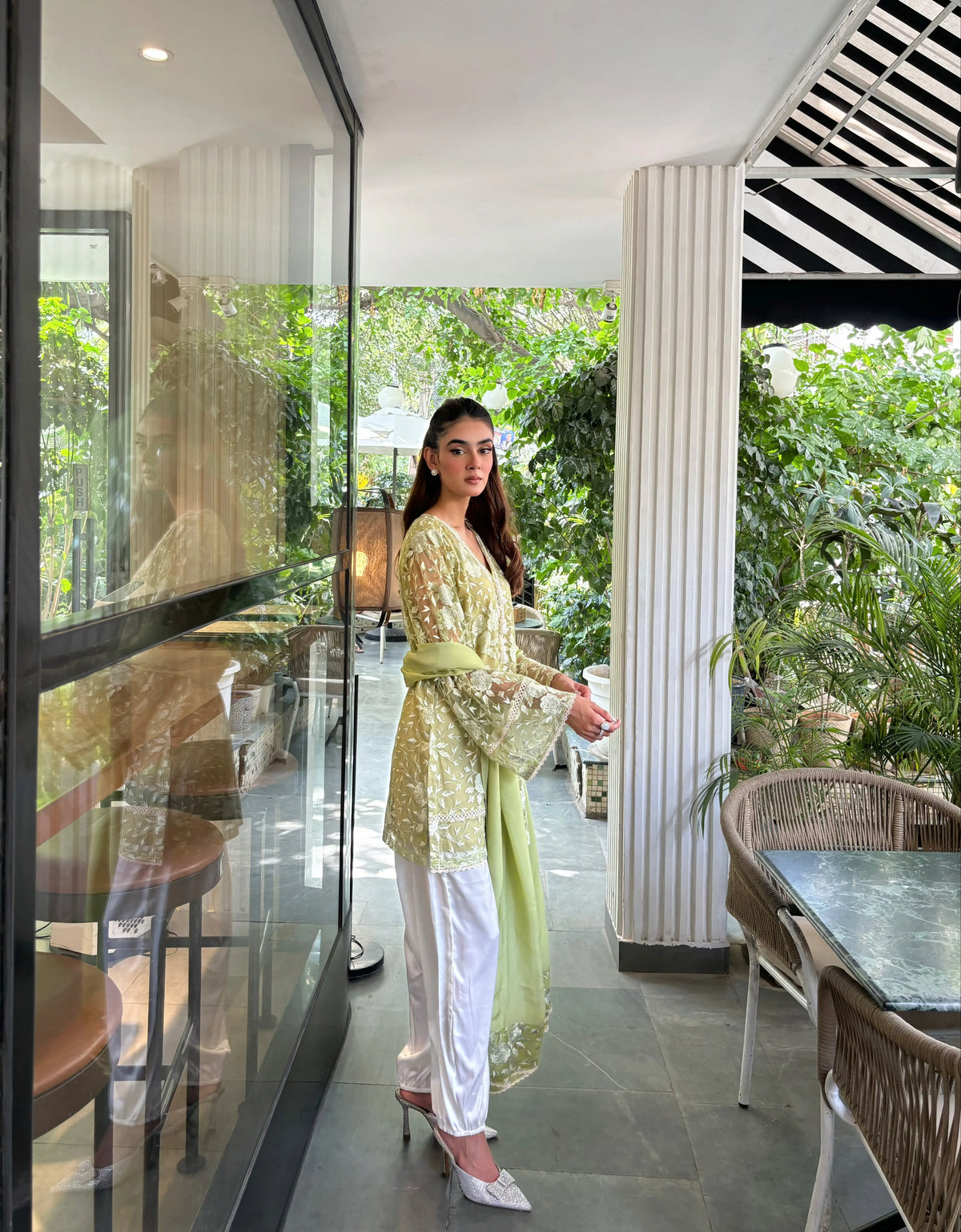
Pyoor's Amelia Coral Green Balloon Set shows how volume can remain light and graceful. The embroidered net kurta has a soft cotton lining and is paired with a white satin balloon salwar. The pastel green organza dupatta continues the softer mood, while tassel and lace detailing brings attention to the neckline and sleeves.
Jewellery can stay delicate here. Let the balloon shape do the talking, and treat this salwar suit for diwali as the statement piece on its own. A slim bangle or bracelet alongside jhumkas would give it enough festive definition without taking away from the pastel palette.
It is an especially useful direction for a celebration that begins during the day and continues into the evening.
Think about diwali colour in terms of mood, not rules
There is no requirement that festive clothing must always be deep red, maroon, gold, or jewel toned. Those shades can look beautiful, but softer colours can be equally appropriate when texture and detailing give the outfit enough presence.
A pastel salwar suit for diwali, for instance, can feel fresh for daytime puja, an afternoon family gathering, or a celebration where you prefer quieter colour. Embroidered net, organza, lace, or subtle surface detail can provide festive texture without relying on intense colour.
At the other end of the spectrum, colour blocking can make the outfit itself the centre of attention.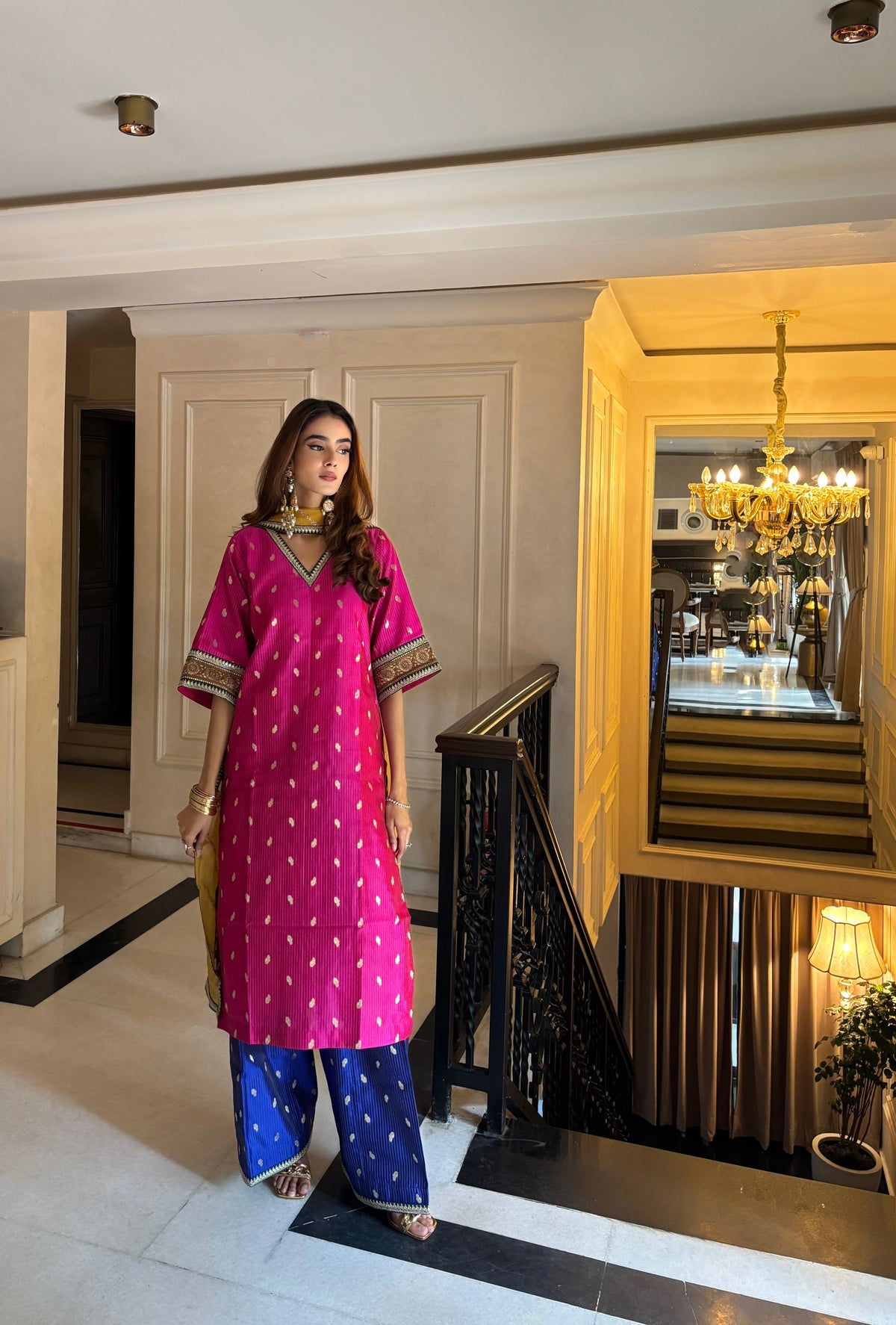
The Bahaar Colorblock Brocade Set with Dupatta takes this route. Its handwoven brocade kurta comes in Rani Pink, paired with a blue colorblock farshi salwar and a yellow embroidered organza dupatta. Lace details at the neck and sleeves soften the stronger colour contrast.
Accessories barely need to work overtime with a piece like this. This kind of salwar suit for diwali already creates its own excitement through colour alone, so jewellery can support the outfit rather than compete with it.
There is another practical advantage here. In evening photographs, stronger colour contrasts often define the silhouette clearly, while a softer palette creates a gentler visual effect. Neither approach is inherently more festive. They simply produce different moods.
Let the dupatta decide how formal the look feels
Dupatta draping is one of the quickest ways to change the personality of a diwali salwar without changing the outfit itself.
For a relaxed family gathering, place the dupatta over one shoulder and allow it to fall naturally. This keeps your hands relatively free and works particularly well with an organza dupatta whose shape and transparency deserve to be visible.
For a more formal salwar suit for diwali, you can arrange the dupatta neatly across both shoulders or bring one side across the front. This creates a more composed appearance for puja, photographs, or a sit down celebration.
There is one detail people often overlook. The prettiest drape is not always the most practical one.
If you know you will be serving food, lighting diyas, greeting guests, or moving between rooms, secure the dupatta discreetly at the shoulder. A drape that needs adjusting every few minutes will become frustrating very quickly.
With a farshi silhouette, try not to hide the shape completely beneath too much fabric at the front. The lower half is part of the design. Let the kurta, salwar, and dupatta each be seen rather than one covering the others. That balance is what makes a salwar suit for diwali actually look finished.
Match jewellery to the neckline, not just the occasion
Festive styling often starts with the thought, "It is Diwali, so I need festive jewellery." A better question is, "What does this neckline need?"
If your salwar suit for diwali has tassels, lace, embroidery, or a visually detailed neckline, large jhumkas may be enough. Leaving the neck relatively open allows those garment details to remain visible.
A simpler neckline can accommodate a necklace more comfortably. You can then choose smaller earrings so the jewellery does not become visually heavy around the face.
This is particularly helpful with gota patti or mukaish work. Both can create enough surface interest that excessive jewellery is unnecessary. Look at the outfit in a mirror from a few steps away rather than close up. If your eye cannot settle on one area, remove one accessory.
It's a small habit, but it's often what separates a polished look from a merely festive one when you're wearing a salwar suit for diwali.
Daytime diwali styling and the evening look need different thinking
A Diwali outfit that looks lovely at noon can feel completely different under warm evening lighting.
For daytime events, lighter colours, softer jewellery, and a relaxed dupatta draping style can work beautifully. The Amelia Coral Green Balloon Set fits naturally into this kind of setting because its pastel green embroidered net, white satin balloon salwar, and organza dupatta create a lighter visual mood.
For an evening look, richer contrast and brocade can carry more visual presence. The Rani Pink, blue, and yellow combination of the Bahaar set offers a bolder direction for a Diwali party.
If you are wearing the same salwar suit for diwali throughout the day, you do not necessarily need a complete change before the evening celebration. Change the jewellery, adjust your dupatta, refresh your makeup, or swap a softer accessory for something more decorative.
One outfit can shift mood with surprisingly small changes.
Farshi, balloon, or simpler salwar: which works for your party?
The best silhouette depends less on trends and more on what the evening actually involves.
A balloon style gives a salwar suit for diwali a playful sense of volume without requiring a heavily structured outfit. It works especially well when the kurta has a lighter appearance and the dupatta remains airy.
A farshi salwar creates more drama around the lower half. If your celebration is dressier, involves formal photographs, or you simply enjoy a fuller traditional silhouette, it can be a strong choice. The Bahaar set uses its blue farshi salwar to create contrast against the Rani Pink brocade kurta.
Simpler salwar shapes make sense when your priority is easy movement or when the kurta itself contains most of the decoration.
What makes it good isn't the silhouette alone. A salwar suit for diwali earns that label when its proportions suit both the garment and the celebration you're actually attending.
That distinction matters. Dressing for the event is often more useful than dressing according to a generic idea of what festive clothing should look like.
Build your party wear around one memorable detail
Try this before your next Diwali party. Describe your outfit in one sentence without mentioning every component.
Perhaps it is "the pastel green outfit with the beautiful balloon salwar." Maybe it is "the Rani Pink brocade look with the blue farshi."
That description reveals the strongest feature of your salwar suit for diwali. Protect it.
The same logic runs through all three cases: an elaborate dupatta shouldn't bury a memorable farshi silhouette, a large necklace shouldn't hide a standout embroidered neckline, and quieter accessories usually suit a colour combination that's already doing the work on its own.
This principle is more useful than simply asking whether an outfit needs more jewellery.
After all the styling, it should still look like your outfit, not someone else's idea of what a salwar suit for diwali ought to be. Accessories are there to finish the story, not rewrite it.
Small practical details that matter once the party starts
Before leaving home, sit down in the complete outfit. Walk around. Raise your arms. Carry your usual bag. Check whether the dupatta stays where you intended it to stay.
These tiny tests reveal far more than standing in front of a mirror.
If your salwar suit for diwali includes a fuller salwar, make sure your footwear allows the fabric to fall comfortably. If you are wearing jhumkas, check that they do not catch repeatedly against the dupatta. Secure delicate draping before the celebration rather than trying to fix it after you arrive.
Comfort is not separate from good festive styling. Someone who can move naturally in an outfit will usually look more at ease in it too.
This is particularly important if your Diwali evening involves several hours of visiting, eating, photographs, and family celebrations. Enjoying it for that entire stretch matters more than how it photographs standing still, so pick a salwar suit for diwali you'd actually want to be in for hours.
Real questions people ask about diwali salwar styling
What jewellery looks best with a salwar suit for diwali?
Look first at the neckline and surface detailing. With embroidery, tassels, gota patti, mukaish work, or decorative lace near the face, jhumkas may provide enough emphasis. If the kurta is simpler around the neckline, a necklace can become the main jewellery piece.
How can I make a simple diwali salwar look more festive?
Focus on one or two changes that are immediately visible. A thoughtful dupatta drape, expressive earrings, or dressier footwear can change the mood without overwhelming a simple outfit. You do not need to add decoration everywhere.
Is a pastel salwar suit for diwali festive enough?
Yes. Festive character can come through embroidery, fabric texture, silhouette, dupatta detailing, and accessories as well as colour. A softer palette can be particularly lovely for daytime celebrations and family gatherings.
How should I style a farshi salwar for a Diwali party?
Allow the farshi silhouette to remain visible. Keep the dupatta from covering too much of the lower half, and consider quieter accessories if the kurta and salwar already create strong colour or texture contrast.
Can I wear the same salwar suit for diwali during the day and evening?
You can adapt the styling rather than changing the entire outfit. Lighter jewellery and relaxed dupatta draping suit daytime celebrations. For the evening, a different pair of earrings, a more composed drape, or slightly stronger makeup can shift the overall mood.
Should my dupatta match my salwar exactly?
Not necessarily. A contrasting dupatta can become an important part of the outfit, particularly when colour blocking is already part of the design. What matters is that the colours feel connected across the complete look rather than each piece appearing unrelated.
Diwali clothes are at their best when you can stop thinking about them once the celebration begins. Choose a salwar suit for diwali that gives you enough comfort to move through the evening, then style around the detail you genuinely love most.
For one person, that might be a soft pastel balloon silhouette. For another, it could be a colourful farshi salwar beneath a rich brocade kurta. Pyoor's festive pieces offer room for both moods.
The final test is wonderfully simple. Put on your salwar suit for diwali, add the accessories you planned, then remove the one thing that feels least necessary. If the outfit suddenly looks clearer, you have probably found the right balance.
0 comments