

You took your favourite salwar suit out of the cupboard in November, and now you're standing at the mirror wondering where the sweater is supposed to go. Small question, annoying answer. Knowing how to wear suit in winter isn't about buying a new wardrobe. It's about the order you put things on and which of them you let show.
Most advice treats a suit like a thin outfit that needs rescuing. That's half true. A kurta and salwar already cover your arms and legs, so you start warmer than someone in a dress. The cold sneaks in through the neck, the wrists, the ankles and the feet. Seen that way, how to wear suit in winter becomes a short checklist.
Below you'll find a layering order that survives a cold 7 am start, a comparison of shawls, cardigans and jackets, footwear that keeps your toes warm, and two real sets. The short answer to how to wear suit in winter, if you're in a hurry, is thin layers, one outer piece and warm feet.
Start with the layer nobody sees
Start closest to the skin and work outward, because how to wear suit in winter is really a question of order. A thermal under kurta does more than any sweater you'll throw on later. Pick a thin one, and pick a neckline that sits lower than your kurta's neck so it never shows. Check the sleeves as well. If your kurta has three quarter sleeves, a full sleeve thermal will peek out at the wrist, so match the thermal to the kurta colour or choose a kurta with full sleeves.
The kurta comes next, then one outer layer. Just one. That's the rule most people break, and it's why winter suits end up looking like a bundle of laundry. Whatever you add should be shorter than the kurta, so a cardigan or jacket hem lands above the kurta hem. When layers get shorter as they move outward, the outfit keeps its line. When they don't, you look boxed in. That's the first real step in how to wear suit in winter without losing the shape of the suit.
Warmth isn't about thickness. It's trapped air. Two thin layers hold more heat than one chunky one, and they peel off easily when the office heater kicks in. Anyone asking how to wear suit in winter on a small budget should start here. A thermal costs far less than a new coat.
The salwar half of how to wear suit in winter is easier. Thermal leggings under a loose salwar add warmth without changing the silhouette. Then socks.
Colour matters more than people admit. Keep the thermal, kurta and salwar in one colour family and let the outer layer carry the contrast. It looks planned, and that planned look is what makes how to wear suit in winter seem easy rather than improvised.
How to wear suit in winter with a shawl, cardigan or jacket
Each outer layer does a different job, so choose by your day, not by what looks prettiest on a hanger.
A shawl or stole is the dressy side of how to wear suit in winter. It drapes, it adds colour, and you can pull it over your head in a cold courtyard. Weddings, festive evenings and indoor work suit it best. A stole is lighter and easier to manage, while a shawl gives more coverage. The catch is that it slips, so if you're carrying a bag or riding a scooter, expect to fix it every few minutes.
A cardigan is the everyday choice. Long open front styles that reach mid thigh work well over a kurta, and sleeves you can push up let you manage temperature. If you're wondering how to style salwar suit in winter for an ordinary workday, this is usually the answer.
A quilted jacket is the warmest of the three and the least graceful. That's fine. It's for the commute, the early train, the school run. A cropped cut keeps it from clashing with the kurta hem, and it comes off the moment you're indoors. For how to wear suit in winter on days that start at 6 am, this is the one that earns its place.
Now the point most guides skip: choose structure or drape, not both. A jacket has structure. A shawl has drape. Wear them together and they fight at the shoulders. If you must double up, wrap a thin stole around the neck like a scarf instead of draping it. That one change is the difference between layered and cluttered, and it's the kind of detail in how to wear suit in winter that people usually learn by getting it wrong.
Wedding season changes how to wear suit in winter a little, since heavy layers have to survive photographs. Our post on stylish winter wear for ladies goes into that side of it.
Footwear and socks, where most winter outfits go wrong
Feet get ignored in most advice on how to wear suit in winter. Then they get cold, and nothing else matters.
Closed juttis are the traditional answer, and they work with socks if you size right. Go up half a size, wear thin cotton or woollen socks in a shade close to your salwar, and the sock more or less vanishes at the hem. Open sandals with socks rarely look intentional.
Boots are the trickiest part of how to wear suit in winter, and they suit tapered salwars and pants best. With a wide salwar the hem bunches around the boot shaft and drags. If you love boots, check that the mori, the opening at the hem, is narrow enough to sit cleanly over or tuck into the boot.
Honestly, if you only fix one thing after reading this, fix the feet. It's the cheapest upgrade in how to wear suit in winter, and it decides how long you can stay outside.
What to wear on salwar suits in winter, day by day
Here's how to wear suit in winter across the situations that come up most.
-
Office or college: thermal, full sleeve kurta, long cardigan, closed juttis with thin socks. Keep a stole in your bag for the cold meeting room.
-
Early commute: thermal, kurta, cropped quilted jacket, thermal leggings, ankle boots or sneakers.
-
Wedding or festive evening: thermal, embellished kurta, a shawl draped on both shoulders, closed juttis. No jacket. Let the shawl do the work.
- Home and errands: a soft kurta set, a cardigan you can drop on a chair, and socks.
Notice that how to wear salwar suits in winter changes less than you'd expect from one scenario to the next. The thermal and the socks stay. Only the outer piece and the shoes move around. That's useful, because how to wear suit in winter then needs only two or three outer layers, not a separate wardrobe.
One more question people ask is how to wear indian suits in winter when the fabric itself is light, like cotton or chanderi. The answer barely changes. How to wear suit in winter still starts with the same layering order, with a slightly heavier thermal and a stole that has some weight. A fabric with no warmth of its own is a perfectly good base. The layers carry the load.
Two sets that already do some of the layering
Some sets arrive with the outer layer included, which saves you the matching game. They don't replace everything above, but they shrink the decisions in how to wear suit in winter.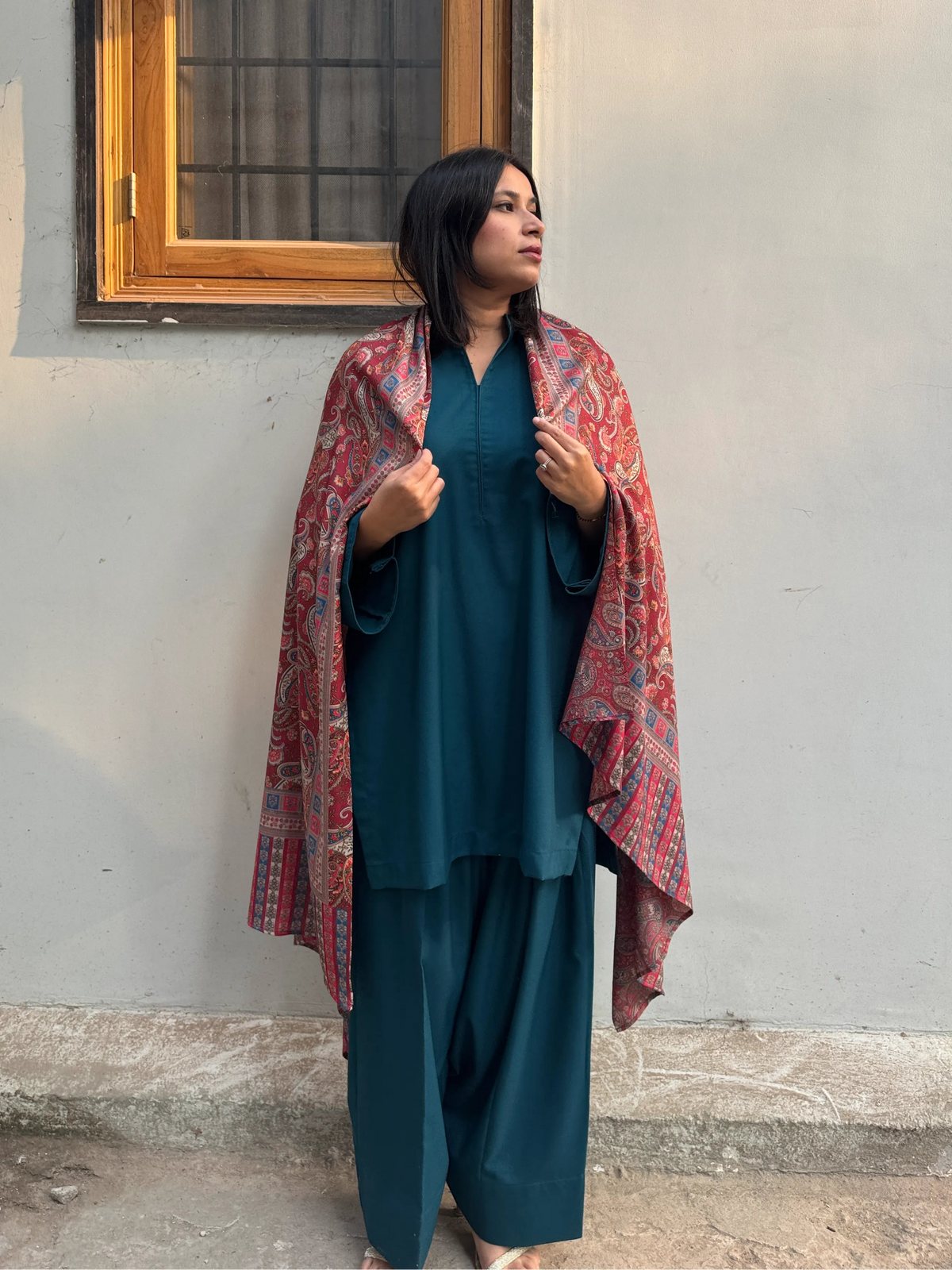
The Solids Ferozi Green Winter Spun Set is a good example. The kurta comes in our signature oversized fit, paired with a matching spun farshi salwar, and both are made from winter spun fabric. A printed pashmina stole of 2 meters comes with it, which gives you a ready made finishing layer in the same colour story. That makes it a handy case study for how to wear suit in winter with a stole. There are pockets, a 12 inch salwar mori and a 3 inch feasing. An oversized cut generally leaves space for a thin thermal underneath, and the 12 inch mori is worth testing against your boots before you commit to a pairing.
The Dhaaga Navy Blue Winter Kurta Set with Pashmina Shawl takes a slightly different route. The kurta is in the oversized box fit, paired with comfortable pants and a contrasting pashmina shawl, all in premium pashmina spun fabric. Delicate lace detailing runs across the kurta and the shawl, and there are functional pockets. It shows how to wear suit in winter when you prefer pants over a salwar. The contrasting shawl follows the colour rule from earlier. Check the hem details on the product page before pairing it with boots.
Neither set removes the need for socks and a thermal on really cold mornings. What they do is turn how to wear suit in winter into a matter of choosing shoes, not hunting for a matching shawl. For fabric and care details, the product pages are the place to check.
If fabric is the sticking point in how to wear suit in winter, the comparison of pashmina or woolen suit may help once it's live. And if you'd rather see more sets in one place, our winter suit sets for women collection is there when you need it.
Questions people ask
How to wear suit in winter without looking bulky?
Use thin layers instead of one thick one. A thermal under the kurta, one outer piece such as a cardigan or shawl, and thermal leggings under the salwar keep you warm without adding width. That's the core of how to wear suit in winter without bulk. Make sure each outer layer ends higher than the kurta hem, and keep the inner layers close to the kurta colour.
What can I wear under a salwar suit in winter?
A thin thermal top with a low neckline sits under the kurta, and thermal leggings sit under the salwar. Socks finish the job. Choose a thermal sleeve length that matches your kurta so nothing peeks out at the wrist.
How to wear salwar suits in winter to the office?
A long open cardigan over a full sleeve kurta is the simplest combination. Closed juttis with thin socks keep the feet warm and look sharp, and a stole in your bag handles the over cooled meeting room.
Can you wear juttis in winter?
Yes, as long as they're closed. Go half a size up so a thin sock fits, and pick a sock colour close to your salwar so it blends in at the hem.
Is a shawl enough, or do you need a jacket?
A shawl is enough indoors and for evenings, since it adds real coverage over the shoulders. For early mornings, a commute or an open terrace, a jacket holds heat better. If your day mixes both, a cardigan plus a stole you can remove is the safest bet, and it covers how to wear suit in winter for most ordinary schedules.
Tonight, pull out one suit you already own and test how to wear suit in winter with this order: thermal, kurta, one outer layer, socks. Check where the hems land. If it looks off, the outer layer is usually too long.
0 comments