

Every year around this time, the same question comes up in group chats and family calls: what are you wearing for Diwali? If you're still scrolling through options trying to find a diwali dress that actually fits how your celebrations look this year, you're not alone. Between the puja at home, the evening gathering at your in laws, and maybe a friend's card party, one diwali dress rarely covers everything, and that's really the problem worth solving here.
What Actually Makes a Diwali Dress Work
A diwali dress isn't just about picking something festive off a rack. It has to survive standing near diyas and candles for hours, sitting cross legged during the puja, and still look put together when the photos come out later that night. One that creases the moment you sit down, or comes with a dupatta that needs constant adjusting, tends to ruin an otherwise good evening.
Net and organza with a proper lining underneath are forgiving in a way plain silk often isn't, which is why so many good diwali dress options lean on these fabrics. They hold their shape through the evening without clinging or creasing badly, and a soft cotton lining means you're not itching through the aarti. If your celebration involves a lot of moving around, from the kitchen to the living room to the balcony for the fireworks, a diwali dress with breathable layers matters more than people admit, and it's worth checking the lining before anything else.
Colour is where most of the actual decision making happens when picking a diwali dress. Deep jewel tones like maroon and emerald have their season, but this year a lot of women are leaning into softer pastels for daytime functions and saving the richer shades for the evening. A pastel diwali dress photographs beautifully under fairy lights without competing with the gold jewellery everyone tends to bring out for the occasion, and it's become one of the more requested choices this year.
Choosing the Right Diwali Dress for Your Celebration
Start with where you'll actually be wearing your diwali dress, not with what looks good on a model. A daytime puja at home calls for something comfortable enough to sit in for an hour without fidgeting. A farshi set with its flowing silhouette looks stunning in photos but can be a genuine hassle for a diwali dress if you're moving between rooms carrying prasad trays.
For evening functions where you're mostly standing, chatting, and posing for pictures, a farshi salwar suit earns its reputation as a diwali dress that photographs well. The fabric pools nicely at the ankles when you're standing still, and gajji silk in particular carries a weight that makes it drape rather than float, which reads as more occasion appropriate under evening lighting.
If you're someone who ends up doing a bit of everything across two or three days of celebrations, it helps to think in terms of a small rotation rather than one perfect diwali dress for women. One lighter piece for the daytime rituals, one richer outfit for the evening party, and you've covered both without either one feeling wrong for its setting.
Mukaish work and gota patti embroidery are worth checking closely before you commit to a diwali dress, not just glancing at from a product photo. Hand finished mukaish catches light differently depending on the angle, giving a subtle shimmer rather than an obvious sparkle, while machine done versions can look flat under indoor lighting. It's a small detail, but it's usually the difference between an outfit that photographs well and one that just looks busy.
Styling a Diwali Dress Without Overdoing It
The instinct during Diwali is often to add more, more jewellery, more embroidery, more everything, especially once you've settled on a diwali dress. But a piece with detailed embroidery already carries most of the visual weight on its own, so the jewellery around it can afford to be simpler than you think for a diwali dress. A statement neckpiece against a heavily worked outfit usually competes rather than complements.
Footwear gets overlooked more than it should when styling a diwali dress. Farshi sets are cut long by design, so heels that add too much height can throw off the proportion a diwali dress was meant to create. A low block heel or even a comfortable juti tends to sit better under a flowing salwar than a stiletto does, and you'll actually be able to walk normally by the third hour of the evening.
If the dupatta on your diwali dress has organza or net with embroidery along the border, let it do the talking instead of pinning it down completely. A loose drape over one shoulder, with just enough structure to keep it from sliding off, looks more relaxed than something pinned flat across the chest. It also means you're not constantly readjusting it between conversations.
Farshi Set, Salwar Suit, or Something Else Entirely
This is where a lot of the actual confusion happens when shopping for a diwali dress, because these terms get used loosely and it's easy to end up with the wrong silhouette for your event. A salwar suit, in its more fitted, everyday form, works well as a diwali dress for smaller gatherings or if you're going to be on your feet running the household for most of the evening.
A farshi set is a different commitment altogether as a diwali dress. The salwar is cut to pool at the floor rather than sit at the ankle, which means it genuinely needs a bit more space to move in and isn't the first choice if you're squeezing between chairs at a crowded family function. It comes into its own at larger evening events where there's room to actually let the silhouette fall the way it's designed to.
Somewhere between the two sits the balloon cut, which has picked up a following as a diwali dress for exactly the reason a straight fitted suit sometimes doesn't work for everyone. The volume through the salwar gives movement without the length of a full farshi, so this style suits people who want the drama of a fuller silhouette but need to stay practical through a long evening.
A Closer Look at Two Options Worth Considering
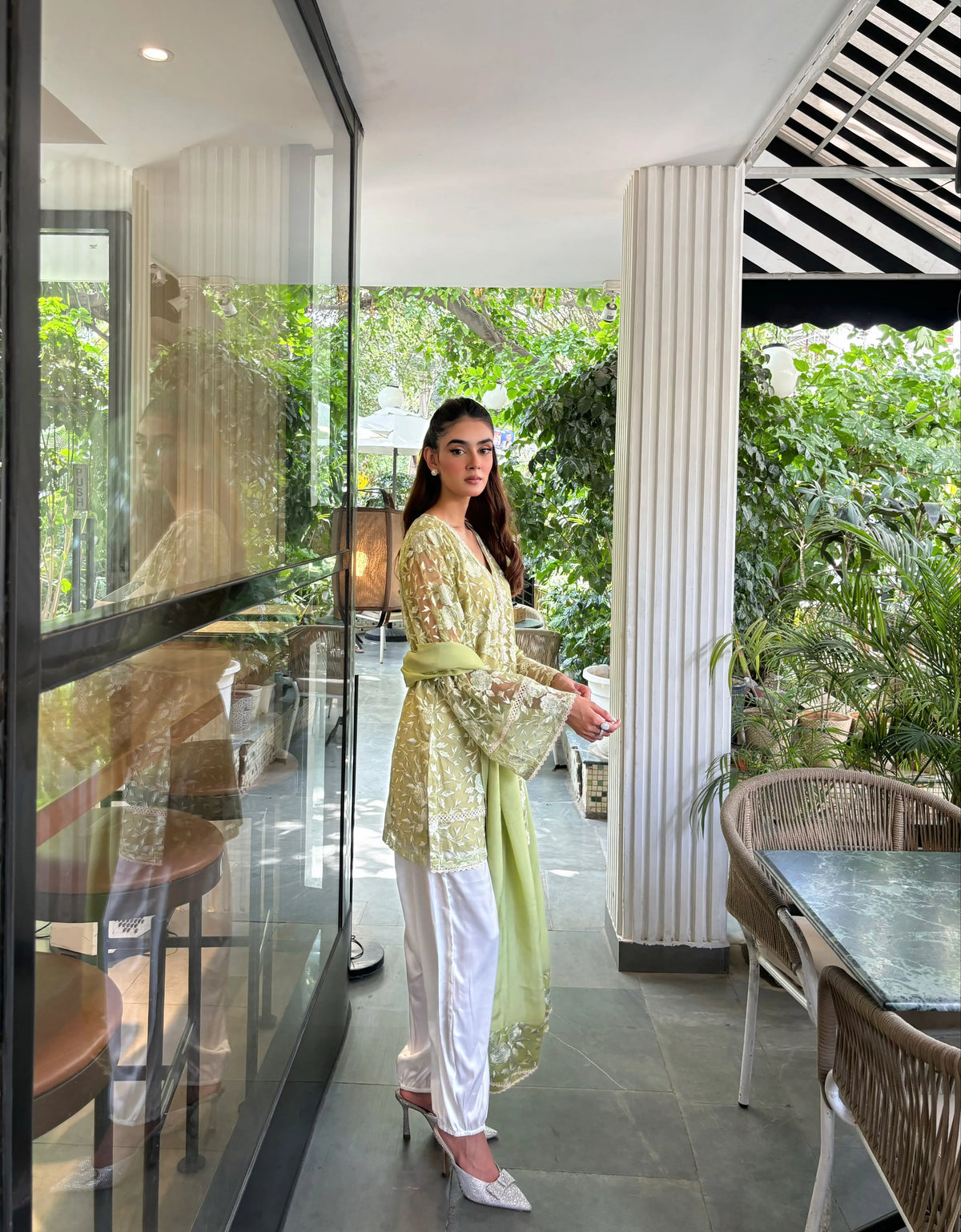
The Amelia Coral Green Balloon Set is a good example of a diwali dress that hits that middle ground. The embroidered net kurta comes with a soft cotton lining, so it holds up through a longer stretch of wear, and the white satin balloon salwar creates that flowing movement without going all the way to a full farshi length. The pastel green tone makes it work particularly well for a daytime puja or an early evening gathering where you want something festive that doesn't feel heavy. The tassel and lace detailing along the neckline keeps it from looking plain without turning it into a fussy outfit, and the organza dupatta in the same shade ties the whole look together.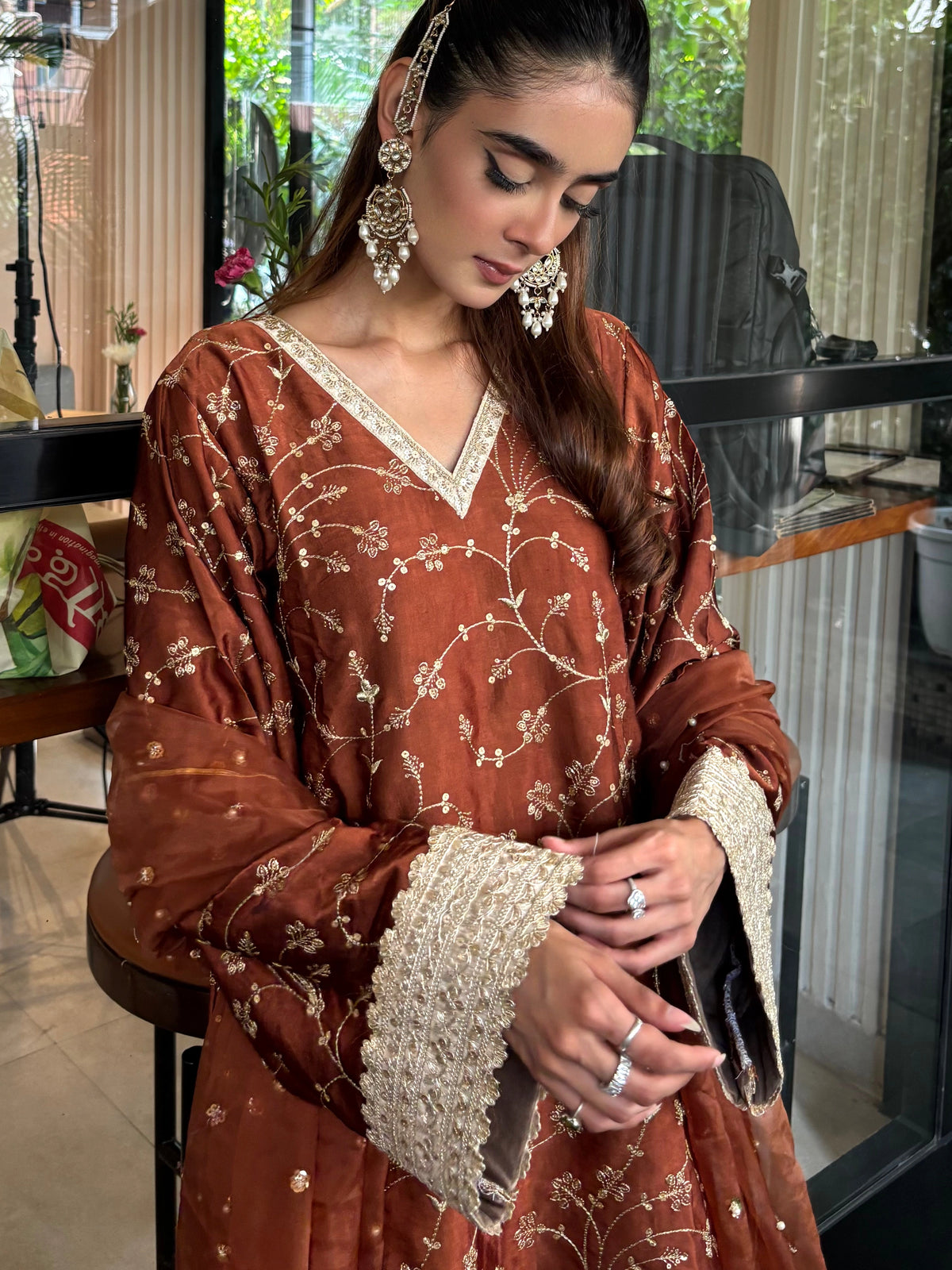
For something with more presence, the Mehreen Brown Silk Farshi leans into the richer end of the spectrum as a diwali dress. Pure gajji silk holds embroidery differently than lighter fabrics, giving it a depth that shows up well in evening lighting, and the straight, roomy cut lets the fabric fall naturally instead of clinging as you move through the evening. Because the farshi salwar is worked in matching silk and embroidery, the kurta and bottom read as a single piece rather than two separately styled halves, which is exactly the kind of detail that separates a genuinely well made farshi set from one that just looks the part in photos. The brown organza dupatta, hand embroidered and left light enough to drape rather than weigh down the shoulder, rounds off an outfit built for the kind of evening where you're on your feet for hours.
Real Questions People Ask About Diwali Dresses
How early should I buy my diwali dress?
Most tailoring adjustments, if your outfit needs any, take a week or two depending on how detailed the embroidery is. Buying at least three weeks ahead gives you room for alterations without the last minute scramble that tends to happen closer to the festival.
Is a farshi set too much for a smaller home gathering?
It can read as slightly formal for a very casual, intimate setup. A salwar suit or the balloon cut style tends to feel more appropriate when you're mostly seated at home rather than moving through a larger venue.
What fabric holds up best through a long evening?
Gajji silk and embroidered net with a proper lining both perform well over several hours, since neither creases as badly as plain silk can. If you know you'll be standing for extended periods, this matters more than the print or colour.
Can I wear a pastel diwali dress for the evening functions too?
Yes, pastels work perfectly well after dark, especially under warm indoor lighting where they don't wash out the way they sometimes can in harsh daylight. Pairing a lighter shade with slightly heavier jewellery usually balances it out for an evening setting.
Do I need a dupatta with every diwali dress for women style?
Most farshi and salwar suit sets are designed with the dupatta as part of the overall silhouette, so leaving it off can change how a diwali dress falls and photographs. It's worth trying the full set together before deciding to skip it.
If you're still narrowing things down, it helps to actually look at the pieces up close rather than just scrolling past them. Pyoor's diwali collection has both of these diwali dress styles, plus a few more, worth comparing side by side before the festival rush makes it harder to find the diwali dress you actually wanted in your size.
0 comments